Online Quran Reading with Tajweed
Build Quran reading accuracy through one-to-one practice in connected passages. For students who recognise Arabic letters and can attempt joined words, lessons focus on vowels, pronunciation, stopping and applying familiar Tajweed rules.
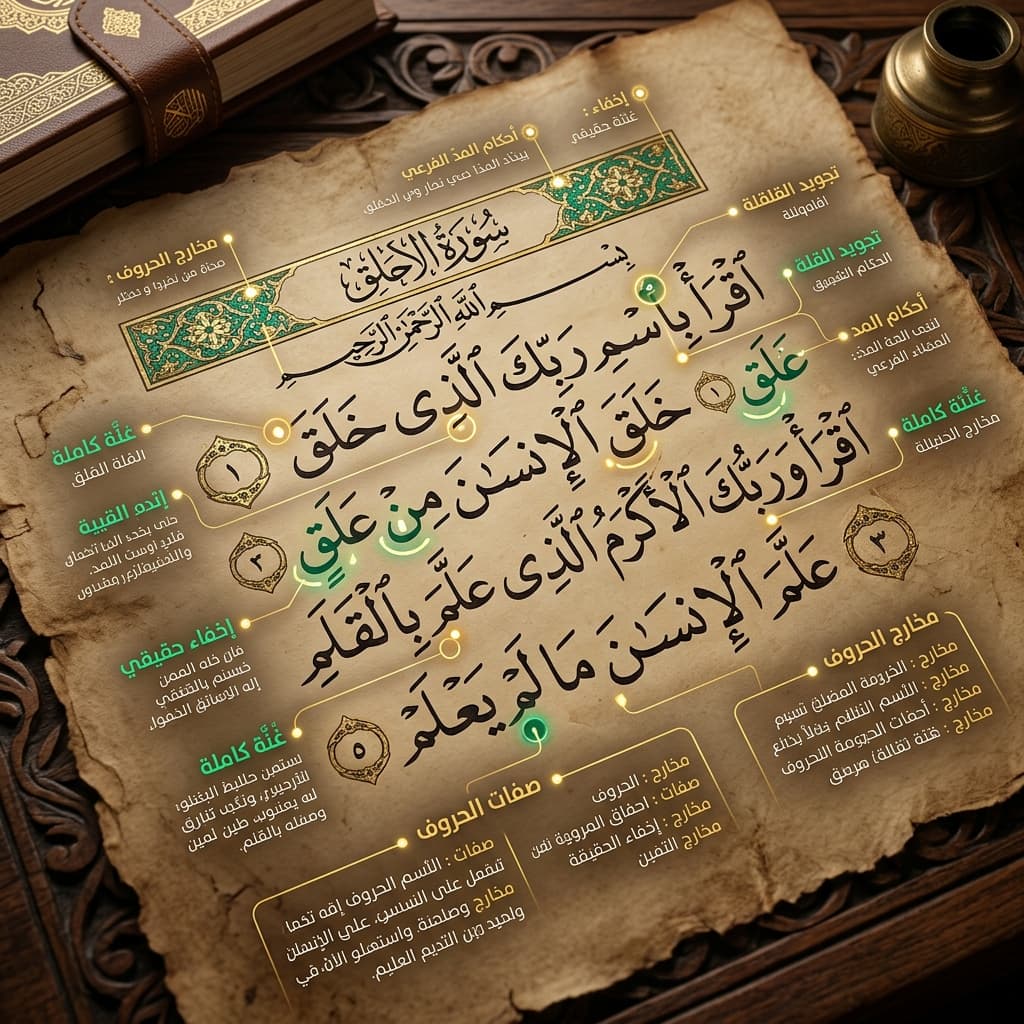
Start with a free one-to-one trial and discuss your level with a Quran teacher.
Start with a free trial
Find the right starting point for your Quran lessons
Request a trial for Quran Reading with Tajweed. Share your learning level and local time so we can discuss a suitable teacher and schedule.
- 1. Send your request using this form.
- 2. Confirm your teacher, lesson format and trial time with our coordinator.
- 3. Try the lesson before deciding on regular classes.
Request your trial class
About this course
What to expect from Quran Reading with Tajweed
Build Quran reading accuracy through one-to-one practice in connected passages. For students who recognise Arabic letters and can attempt joined words, lessons focus on vowels, pronunciation, stopping and applying familiar Tajweed rules.
The student reads aloud while the teacher identifies recurring errors, models corrections and checks the same skill in another passage. Accuracy and retained corrections come before reading faster.
Who these lessons suit
- Learners who have studied Qaida and can attempt joined words
- Returning readers needing pronunciation feedback
- Children and adults building connected reading confidence
Quran Reading with Tajweed: course syllabus
Discuss the starting module during your trial. Readiness and retained skills determine when to move forward.
Module 1
Check the reading foundation
- Read unfamiliar joined words
- Identify missing or confused vowel marks
- Review foundations that interrupt connected reading
Module 2
Passage practice
- Read a short section aloud
- Practise pronunciation and vowel length
- Discuss stopping and restarting points
Module 3
Independent application
- Read a new passage using earlier corrections
- Revisit difficult words
- Review readiness for Tajweed study or memorization
Planning your quran reading with tajweed lessons
Passage fluency first — not a rules syllabus
Choose this page when the main goal is reading continuous Mushaf lines with fewer prompts. Lessons open with the student reading aloud; the teacher interrupts for vowels, joins, stopping and pronunciation that block fluency. Rule names appear only when they clarify the mistake. If you want a module-by-module Tajweed syllabus instead, use Learn Quran with Tajweed.
Who should start here after Qaida
Ideal after Noorani Qaida or equivalent letter joining. A readiness check uses an unfamiliar combination and a short Juz Amma line — not only memorized Surahs. If letters are still confused outside a practised row, return to Qaida first. If letters are secure but connected reading stalls, this reading track is usually the better fit.
Home practice that builds independence
Ask for one short ayah set and two correction targets (for example Kasrah length and Waqf). Shadow the teacher’s model, then re-read without looking at notes. Mark every word that still needs a prompt. Avoid racing through pages; repeating the same error across a long target does not create fluency.
Signals you are ready for Tajweed intensive or Hifz
When unfamiliar lines need fewer prompts, vowel length is steadier and stopping points are intentional, discuss either a dedicated Tajweed rules course, an intensive correction plan or a separate Hifz track. Reading fluency is preparation — it is not the same as memorization revision or an Ijazah pathway.
Parents: what to observe in the trial
Watch whether your child can attempt the next word without constant translation, whether corrections are short enough to retry immediately, and whether the homework size fits school evenings. Ask the teacher which Mushaf or digital text will be used and how missed days are handled before you pick a weekly frequency.
Skills to work towards
- Read unfamiliar joined words with fewer prompts
- Apply familiar Tajweed rules in connected reading
- Pause at agreed stopping signs
- Retain corrections when returning to a passage
Review these goals with your teacher. Progress depends on the starting assessment, practice and the support each learner needs.
Quran Reading with Tajweed: common questions
Is this Quran reading course for complete beginners?
It is for learners who recognise Arabic letters and can attempt joined words. Complete beginners are better assessed for Noorani Qaida or the beginner pathway.
Will I learn Tajweed during reading lessons?
The teacher can explain and correct rules encountered in your passage. For a topic-by-topic rules syllabus, compare the separate Learn Quran with Tajweed course.
Will reading faster be the main goal?
Accuracy comes first. The teacher should check pronunciation, vowels and suitable stopping before encouraging greater fluency. Speed alone does not show that corrections have been retained.
Can I start after finishing Qaida elsewhere?
Yes. Mention your earlier study and read an unfamiliar example during the trial so the teacher can check which foundations are secure and which need revision.
Are these classes also a Hifz programme?
Reading and memorization are different goals. Reading lessons can prepare the foundation for Hifz, but a memorization programme needs a separate new-lesson and revision routine.
Review your progress and next learning step
Use these checkpoints with your teacher, then choose a related course or guide when you are ready.
Useful progress checkpoints
- Read joined words without guessing from memory.
- Apply vowel length and familiar Tajweed rules during real recitation.
- Notice stopping signs and ask about unfamiliar ones.
- Return to a passage later and read it with fewer corrections.
Quran Reading with Tajweed Tuition Plans
Choose a plan that fits your schedule and budget. All plans include one-to-one lessons, 30-minute live classes, and a free trial class before you commit.
Basic
Light PacePerfect for beginners or those with a busy schedule who want consistent, manageable progress.
- 2 classes per week (8 / month)
- 30 minutes per one-to-one class
- One-to-one Quran lessons
- Flexible 24/7 scheduling
- Free 3-day trial evaluation
- WhatsApp & coordinator support
- Monthly progress report
No credit card required
Standard
Our most popular plan — the perfect balance of consistency and affordability for steady progress.
- 3 classes per week (12 / month)
- 30 minutes per one-to-one class
- One-to-one Quran lessons
- Flexible scheduling & easy make-up
- Free 3-day trial evaluation
- WhatsApp + Email dedicated support
- Bi-weekly progress report
- Homework & practice materials
No credit card required
Premium
Intensive TrackFor dedicated students who want maximum progress, including Hifz and intensive Tajweed programs.
- 5 classes per week (20 / month)
- 30 minutes per one-to-one class
- One-to-one Quran lessons
- Priority scheduling & timing choice
- Free 3-day trial evaluation
- WhatsApp + Email + Phone support
- Weekly progress report
- Homework & practice materials
- Course completion certificate
- Ideal for Quran memorization (Hifz)
No credit card required
Multiple Children or Family Plan?
Get up to 15% sibling discount and customized weekend timetables.
Explore All Family Courses
Discover specialized Quran programs designed for children, ladies, beginners, and advanced memorizers.
View All Courses